

UX Trends 2026: How Emotional Design Drives Real User Engagement
UX in 2026 is no longer a visual discipline — it’s emotional architecture. The brands winning at user engagement design are the ones removing friction, building trust, and creating experiences so intuitive that technology disappears.
UX as Emotional Architecture
Eighty-eight percent of consumers won’t return to a website after a bad experience. Not a slow one. Not an ugly one. A bad one. That distinction matters.
For years, UX was treated as a visual discipline — color palettes, typography, layout grids. That era is over. The brands gaining ground in 2026 understand that UX is emotional architecture. It’s the difference between a user who bounces and one who buys, returns, and refers.
Personalization, speed, and ethical data handling are no longer differentiators. They’re the baseline. Users arrive with expectations shaped by Spotify, Netflix, and Apple. When your digital experience falls short of that standard, they feel it — even if they can’t articulate why. The goal isn’t to impress users. It’s to remove every reason they might hesitate, doubt, or leave.
Frictionless experiences convert casual browsers into loyal customers. That’s the business case for emotional UX design.
Personalization and Frictionless Security
Effortless Personalization
The best personalization is invisible. Spotify’s dynamic interface shifts based on your listening patterns — time of day, mood signals, recent behavior. Netflix doesn’t show you a catalogue; it shows you your catalogue. These aren’t features users notice. They’re experiences users feel.
In 2026, user engagement design demands real-time behavioral adaptation: customized dashboards, predictive content sequencing, and interfaces that learn without asking. Users shouldn’t have to configure their experience. The experience should configure itself.
Biometric Security
Password friction kills conversions. Studies on biometric authentication consistently show significant reductions in login abandonment when facial recognition or fingerprint scanning replaces traditional password flows. The principle is simple: security that doesn’t feel like security is better security.
When a user unlocks your platform with a glance, they don’t think about authentication. They think about what they came to do. That cognitive shift is worth more than any feature you could add.
Generative UI
This is the 2026 innovation most brands are sleeping on. Generative UI refers to interfaces that reconstruct their own layout in real time based on a user’s accessibility needs or cognitive style. A user with dyslexia gets increased letter spacing and a different font. A low-vision user gets higher contrast and larger tap targets. A user with cognitive fatigue gets a simplified layout with fewer competing elements.
Personalization isn’t just content anymore. It’s the entire interface.
Interaction, Immersion, and Feedback
Micro-Interactions
A button that responds when you hover. A progress indicator that moves as you complete a form. A celebratory animation when you hit a milestone. These are micro-interactions, and they do heavy psychological lifting.
Duolingo built a loyalty loop around streak counters and celebratory animations. Users don’t just use the app — they feel rewarded by it. The psychology is straightforward: immediate feedback reduces uncertainty and builds confidence. When users know the system is responding to them, they trust it.
Voice and Multimodal UX
Voice search usage continues to grow, particularly on mobile. More than half of all searches are expected to involve voice or image inputs by the mid-2020s. The shift isn’t about novelty — it’s about meeting users on their terms.
Multimodal UX combines voice, gesture, touch, and AI chat into a single coherent experience. For mobile-first audiences especially, reducing reliance on keyboard input removes a layer of friction that costs you conversions.
AR and 3D Experiences
Warby Parker’s virtual glasses try-on and IKEA’s Place app didn’t just create impressive demos. They solved a real business problem: purchase hesitation caused by uncertainty. When users can visualize a product in their space or on their face, return rates drop and purchase confidence rises.
Immersion builds confidence. Feedback builds trust. Together, they create the emotional momentum that drives a user from consideration to conversion.
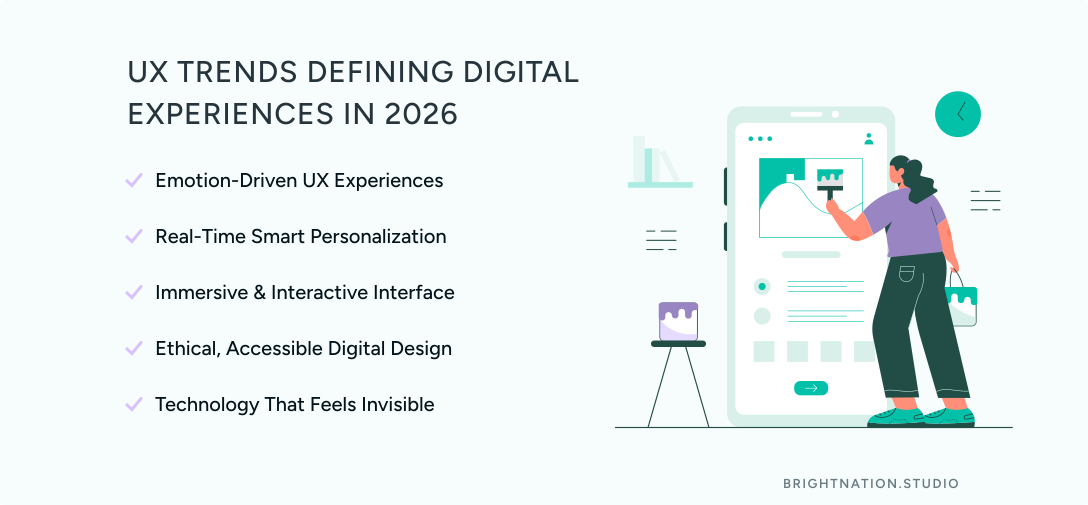
Strategy, Ethics, and the Trust Economy
Data-Driven Design
Gut instinct is expensive. Behavior data is precise. Tools like Hotjar and Crazy Egg give you heatmaps showing exactly where users click, scroll, and abandon. Pair that with A/B testing on CTA placement, content length, and navigation structure, and you’re making design decisions based on evidence, not assumption.
The brands winning at user engagement design aren’t guessing. They’re iterating.
Accessibility as Standard
Over 1.3 billion people worldwide live with some form of disability. Designing for accessibility — proper color contrast, screen reader compatibility, keyboard navigation — isn’t a compliance checkbox. It’s a market reach decision and a brand reputation signal.
Accessible design also tends to be better design. Cleaner layouts, clearer hierarchy, and more deliberate interaction patterns benefit every user.
Cross-Device Consistency
A user who starts a journey on their laptop and continues on their phone shouldn’t feel like they’ve switched brands. Inconsistent experiences across devices cause mid-journey abandonment. Consistent ones build the subconscious trust that keeps users moving toward conversion.
Digital Sobriety
One of the defining UX trends 2026 brings is Digital Sobriety — a deliberate move away from interfaces designed to maximize time-on-screen at any cost. Ethical design respects user attention. It reduces cognitive load rather than exploiting it. It doesn’t use dark patterns to trap users in flows they didn’t choose.
This isn’t altruism. Users are increasingly aware of manipulative design, and they’re choosing brands that don’t exhaust them.
Privacy as UX
Transparent data handling is now a UX feature. Users align their spending with brands that demonstrate respect for their data. A clear, readable privacy policy, explicit consent flows, and honest communication about data use aren’t just legal requirements. They’re trust signals that influence purchasing decisions.
In 2026, UX is about proving you’re a safe steward of user attention and data.
Make Technology Feel Invisible
The best UX is the kind users never notice. It just works.
Personalization that anticipates needs before users articulate them. Security that protects without creating friction. Micro-interactions that confirm every action without demanding attention. Ethics that demonstrate respect rather than just claiming it.
When you get UX right, users don’t think about the interface. They accomplish their goals and come back. That’s the standard worth building toward.
At Bright Nation Studio, we design digital experiences that operate at this level — where strategy, emotion, and technology converge into something users trust. If your current digital experience isn’t creating that feeling, let’s talk about what it would take to get there.